
Bio-based EWI Systems: Construction Skills and Training at Lime Green
Author: Joel Cady, Research Associate, Cardiff University
A key aim of the Transforming Homes Project is to deliver real-life transformation to 1920-1940 council-built homes using bio-based materials. For the demonstration homes in Swansea and Bristol, one of the key focuses is on using External Wall Insulation (EWI) systems incorporating bio-based insulation materials such as wood fibre and lime-based renders. These are a more sustainable alternative to the petrochemical insulation and cement-based renders that are often used in EWI systems because:
- They are often easier, safer and more pleasant to work with.
- They have lower embodied carbon and contain sequestered carbon while they are in use.
- They are ‘vapour open’ so can naturally regulate the movement of moisture vapour through the building fabric.
- They are biodegradable if another use is not found at the end of their lifespan.
The work on the specification and detailing of EWI systems for the demonstration homes in Swansea and Bristol has involved long-term collaboration with partners in the construction industry. This has enabled the design teams to understand currently-available bio-based insulation materials and systems, procedural and regulatory issues around their specification and use, good practice in detailing, and the construction skills and techniques required to install them.
The design team have worked closely with the supply chain including Lime Green, a leading manufacturer and supplier of bio-based insulation and lime render systems based in Shropshire. Led by Managing Director Simon Ayres, Lime Green have provided support throughout the detailed design stages of the demonstration homes and offered training sessions for the teams who will carry out the installation. Recently, they ran a training day for a team at Swansea Council to help them understand the processes and techniques required for the installation of the EWI. Lime Green regularly offer training to designers and installers – as Simon Ayres explains:
Bio based insulation and lime behave slightly differently from the synthetic products most installers are used to, so getting the application right really matters. Hands on training means teams go on site understanding not just how each layer goes on, but why using this material is important and the detailing that will make them perform for decades to come. We’ve always believed that sharing knowledge is as important as supplying materials. If people understand lime and wood fibre, they’ll use them and help create better buildings.
Held at Lime Green’s training facility near Much Wenlock, the session was attended by project managers, site managers and a team of plasterers, all employed by Swansea Council’s in-house contractor. The day focused on two elements of the EWI system that has been specified. Firstly, the lime render products used to prepare the existing brickwork and provide the final weatherproof finish. Secondly, the detailing of the breather membrane applied to the external face of the insulation as an additional layer of protection given the exposed location of the Swansea homes.
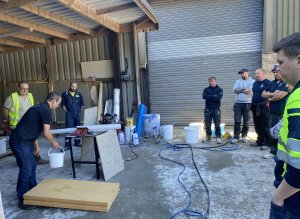
Simon Ayres and colleagues at Lime Green demonstrate the properties of wood fibre insulation and wood-based carrier boards to the Swansea team.
The day was focused on hands-on demonstrations and trial applications of different stages of the installation process, using mockup panels that the Lime Green team had prepared in advance.
The session started with the parge coat, a lime render which will be applied directly to the existing brickwork. Applied with a traditional plasterer’s hawk and float, this provides a smooth and level surface for the insulation to be fixed to. The mix contains an aggregate of hollow glass beads which improves thermal performance and makes application smoother.
Next, the installation of the breather membrane was trialled using a timber mockup of a typical window. This allowed the team to understand the folding and layering required at window cills and reveals to provide robust weatherproof details.
Finally, the team practised applying the plaster finishing coats which will be applied to wood wool carrier boards to form the outer layer of the system. The final coat is a roughcast finish containing relatively large 2-3mm aggregate – this provides a more robust finish with a larger surface area which means it dries out faster when wet.
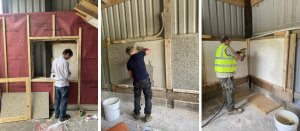
Trialling key stages of the process (left to right): the installation and sealing of the breather membrane at window openings; applying the base coat of render to the carrier boards; the final roughcast topcoat.
It was a valuable day for the whole team and formed a key part of the preparations for starting work on site this autumn. Mark Robinson, the project manager at Swansea Council, said:
‘Getting hands on experience with new materials and systems is invaluable. It builds confidence in products and systems prior to the on-site work, gives the tradespeople opportunity to ask questions and, as in the case of the membrane formation, tests details and specifications.’
Lime Green’s support will continue with site visits to Swansea once the team are ready to install the EWI – many thanks to them from the whole Transforming Homes team. We have learnt a huge amount from Lime Green’s close involvement throughout the process. Once the homes are complete in 2027 two of the key aspects they will demonstrate are the benefits of bio-based EWI systems and the value of interdisciplinary collaboration between housing providers, researchers and the construction industry.