
Expanding Horizons: Sharing Transforming Homes Research Internationally
Authors: Dr Louise King, Research Associate, University of Bath and Dr Lucy McFadzean, Research Associate, University of Exeter
As our research in Transforming Homes continues to evolve, we’ve been actively seeking opportunities to engage wider audiences and deepen conversations around housing transformations and resident co-design. This year, we were delighted to present our work at two major international events, connecting with a diverse range of stakeholders and sharing some of the co-design approaches that sit at the heart of our project.
Creative Design Workshop at the International Social Housing Festival (ISHF), Dublin – Transforming Homes: how community-led design of social housing can ensure retrofit has broad social benefits
Paper Presentation at the International Retrofit Conference (IRC), Salford – Transforming retrofit: how understanding housing as a cultural asset can develop more effective relational and regenerative retrofit designs
These events offered inspiring spaces for exchange – provoking new questions, sparking fresh ideas, and energising our ongoing work. Here, we reflect on two key themes that emerged from sharing our research and learning from others.
- The power of storytelling
Storytelling was a central theme at ISHF. The festival opened with a moving keynote by Katronia O’Sullivan, who spoke about how access to social housing provided the stability she needed to thrive. In sessions like ‘C’mere till I tell ya’, we heard transformative stories of tenant and community engagement from residents across Ireland. These narratives reminded us:
- Why resident voices must be at the centre of retrofit work
- How stories highlight the social value of homes and the importance of caring for both buildings and the people within them
- That storytelling is a powerful tool for change – connecting emotional experiences with policy and design
We carried this inspiration into our own workshop, where participants engaged with stories through household narratives and 3D models, then collaboratively redesigned homes based on those needs. Feedback was overwhelmingly positive – participants felt they gained insight into the transformation process and enjoyed creatively responding to challenges. We look forward to developing this format further to engage new audiences and learn from their expertise.
At IRC, storytelling continued to play a vital role. Sharing resident experiences with an academic audience helped bring our research to life and reinforced a key message from the conference: understanding lived experience is essential to driving meaningful retrofit innovation.
- The strength of interdisciplinarity and international insights
Professor Will Swan of Energy House Labs captured the spirit of interdisciplinarity in his keynote at IRC with a compelling image.
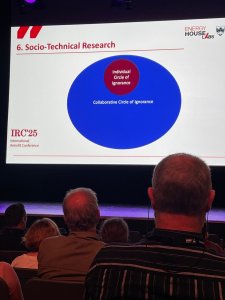
Across both events, we engaged with a wide mix of stakeholders – social housing providers, historians, academics, residents, community land trusts, architects – each offering unique perspectives that expanded our thinking.
Some standout moments included:
- Questions at IRC about using thermal imaging to engage residents in conversations about heat loss and fabric changes
- Ideas at ISHF for adapting our Retrofit Cards and Models to support community land trust discussions around building transformations
International contributions were particularly inspiring. From Barcelona City Council’s innovative housing policies to academic insights on overheating adaptation, we encountered fresh approaches and future-facing challenges that resonate with our work in England and Wales.
These exchanges reaffirmed the value of interdisciplinarity in Transforming Homes. While our project is built on diverse expertise, engaging new audiences continues to raise vital questions and deepen our reflections. Communicating our research across disciplines and borders only strengthens its impact.
We are grateful for the opportunity to share our work and learn from others. These events have not only broadened our reach but also enriched our understanding of what transforming homes can – and should – look like.