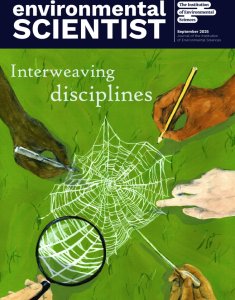
Transforming Homes showcased in the ‘Interweaving disciplines’ edition of the Environmental Scientist, September 2025
Author: Professor Jo Patterson, Director of Transforming Homes, Cardiff University
With Dr Cat Butler, providing the introduction, Dr Louise King an analysis piece and myself contributing an opinion piece, the Transforming Homes team is well represented among leaders working to provide interdisciplinary solutions for critical environmental challenges in the September 2025 edition of the Environmental Scientist ‘Journal of the Institution of Environmental Sciences’.
A foreword from Mike Hulme, Professor of Human Geography at the University of Cambridge reflects on his role as Director of the Tyndall for Climate Change Research between 2000-2007, an experimental interdisciplinary centre funded across three UK Research Councils. He highlights three conditions required for successful interdisciplinary research:
- Teams that contain combinations of people who are natural integrators and holistic thinkers with people who delight in digging into specialist knowledge – foxes (intellectual scavengers) and the hedgehogs (well-drilled specialists).
- Incentive structures that define success for interdisciplinary ventures – moving away from rewarding academic publication through specialist journals only.
- Recognising that researching interdisciplinary solutions to environmental challenges exposes underlying disciplinary differences in disciplines such as ethics, politics and value systems and science should not be endowed with greater authority than it has.
It feels as if we have moved quite a way from tokenistic interdisciplinarity to much deeper forms of collaboration crossing boundaries of social, political, economic and environmental science. Complex issues that we are dealing with require insights from multiple disciplines rather than a single discipline so that opportunities across a system are recognised and challenges are faced and solved – together.
The transformation of our housing stock will rely heavily on collaborative working. Louise’s research in Transforming Homes to date has explored, through interviews and workshops with a wide range of stakeholders, several dimensions of the challenge including the role of governance, planning and policy; equity and social justice in housing; meaningful social consent; and the importance of scaling with purpose. Transformation does not involve isolated measures, rather a set of interconnected whole-house socio-technical solutions. Addressing these diverse dimensions will require technical expertise, governance structures and lived experiences, and doing so through collaborative systemic approaches is critical.
Dr Cat Butler reflects on ‘border trouble’ where issues around assumptions, languages, methods and understanding knowledge can delay and prevent genuine interdisciplinarity. Prioritising communicative and reflexive approaches that allow for openness, humility and respect across disciplines is crucial. Careers of researchers involved in successful interdisciplinary projects need to be recognised and rewarded. They are able to demonstrate the skills highlighted by Prof Hulme – ‘natural integrators, holistic thinkers’ – who have the ability to share research evidence in formats that can be accessed, digested and acted upon.
The actions that Transforming Homes are taking to enable interdisciplinary working are highlighted through my opinion piece, where I reflect on the importance of consistent co-design and flexibility; reciprocal benefits; clearly defined roles and responsibilities; and skills and training. Both Transforming Homes applications were co-designed with intellectual and organisational structures embedded from the start, involving academics from a broad range of disciplines alongside residents, community groups, government, social housing sector and a range of industry partners, with research activities following. A real mix of foxes and hedgehogs!
Recognition of the additional time, and therefore financial resource, required to enable true interdisciplinary working through regular and focussed connection, communication and collaboration is fundamental to enable new knowledge and valuable evidence to inspire and to be impactful. The Transforming Homes team are extremely grateful to the Arts and Humanities Research Council for recognising this through their Green Transition Ecosystem funding.
Read the full ‘Interweaving disciplines’ edition here.