
Closing the Building Performance Gap: Why Full-Scale Measurement Matters
Authors: Dr Andy Shea, Co-investigator, University of Bath; Dr Francis Moran, Research Associate, University of Bath; and Dr Neal Holcroft, Research Associate, University of Bath.
The performance gap in buildings – the stark difference between design expectations and real-world outcomes – is one of the construction industry’s most persistent and costly challenges. While advanced modelling and design research are essential, they’re rarely enough on their own. To close the gap, we need something more tangible: large-scale prototype testing and measurement.
Full-scale measurement provides insight into how buildings and building elements perform. It replaces assumptions with evidence and theoretical performance with real data. Temperature and humidity gradients, temporal and spatial heat flux variations – full-scale measurement captures it all. Full-scale testing of building elements – particularly those incorporating novel materials – helps to rapidly diagnose issues and deliver buildings that meet their design intent. With verified performance, researchers, manufacturers, and designers can validate their work and policymakers can drive real change, using hard data to support more effective regulations, incentives, and standards.
The former RAF Wroughton airfield on the outskirts of Swindon is home to the University of Bath’s Building Research Park. Within the site resides the University’s Large Environmental Chamber (LEC).
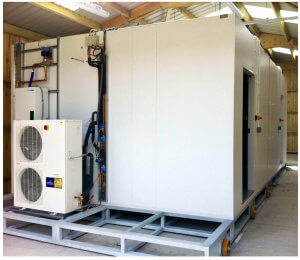
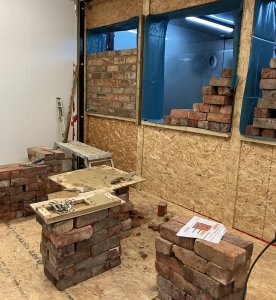
Left: External view of the Large Environmental Chamber; Right: View of walls under construction within the chamber.
The LEC comprises two rooms with a combined volume of over 80 m3. One room mimics the internal environment, e.g. a living room or cellular office space, and the other mimics the outdoor environment. Relative humidity and temperature can be maintained at fixed levels or programmed to vary with time. Temperature can be varied from -20°C to + 40°C and humidity between 10% and 95% RH. Prototype test walls are constructed (either built in-situ or delivered prefabricated) between the two rooms and environmental conditions are programmed to reflect conditions in the real environment.
A team from the University of Bath constructed four wall panels to represent the walls of the real homes being studied as part of the Transforming Homes project. Samples of bricks and cavity insulation were taken from real homes in Bristol and measured in the laboratory to determine their dry density and water absorption characteristics. The team then purchased reclaimed bricks from a local architectural salvage company which were from the same period of construction. From that supply, bricks of appropriate density were selected for the construction of the four walls. At the time of construction of the real homes the cavity walls were unfilled but many have since been filled with insulation. For the large-scale testing, three of the four walls were filled with mineral wool insulation.
To record material and environmental conditions, two bricks in each leaf of each wall were instrumented with sensors to measure temperature and moisture content. Additional relative humidity and temperature probes were installed within each wall cavity, with heat flux plates and surface temperature sensors bonded to the surface of each wall. Finally, the room air temperature and relative humidity was measured in both the indoor and outdoor chamber and data from all sensors were recorded every 5 minutes by a series of data acquisition devices.
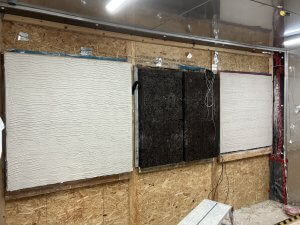
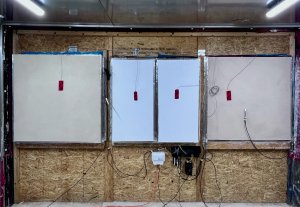
Left: External face of the walls during retrofit; Right: External face of the walls after EWI, render, and paint.
Following a 60-day monitoring of the walls in their existing state the chamber operation was paused and the four walls were retrofitted with a range of different external wall insulation (EWI) materials including woodfibre and cork, which were added to the external face and then rendered. One of the test walls was partially deconstructed and the entire outer leaf of brick replaced with a highly insulated timber frame and rainscreen solution to investigate deeper retrofit options. Once all walls were retrofitted there followed a drying period which was then followed by a 40-day post-retrofit monitoring campaign.
Results of the monitoring campaign have allowed us to compare pre- and post-retrofit thermal performance, as defined by the wall thermal transmittance (U-value), evaluate the occurrence and impact of condensation, and evaluate the response of the pre- and post-retrofitted wall elements to changes in environmental conditions. Ongoing analysis is helping us to calibrate hygrothermal computer models and the experience of designing, sourcing, constructing and retrofitting these walls at scale has provided an incredibly valuable body of data that will inform future research and application.