
The Role of Design Research in developing a Transforming Homes Catalogue
Authors: Joel Cady and Laura Brain, Research Associates, Cardiff University
The preparation of a ‘Design Catalogue’ offering a suite of scalable and transferable proposals for the transformation of 1920-1940 Council built homes is a central component of the Transforming Homes Project. This demands a different approach to conventional architectural practice, which addresses particular opportunities and constraints for a single site or building. Instead of a single site, our scope is 1.4 million homes across England and Wales. And instead of one client, we must develop an understanding of the needs of millions of households, alongside a complex landscape of stakeholders involved in housing transformation, each with their own priorities, limitations and perspectives. To approach these challenges, we have used several design research methods, explored below using Christopher Frayling’s three categories of research: into, through and for Art and Design.
Firstly, we have used research into design to develop a detailed understanding of the homes themselves through their history and original design intent. Council-built interwar homes comprise a relatively small number of largely standardised types, based on designs and specifications issued by the government from 1918 onwards. Our research has shown that, from Carlisle to Carmarthen, layouts and construction methods are strikingly similar, so wherever they are located, these homes share many of the same challenges and opportunities. Understanding this, and the rationale behind the original designs, has allowed us to trace connections between the pastoral ideals of early 20th century architects and poorly performing eaves in homes today; and between historic inequalities in year-round food availability in rural and urban communities and whether an under-stairs cupboard can accommodate a modern water cylinder.
Secondly, we have undertaken research for design through physical surveys, monitoring and modelling, and extensive engagement with residents and stakeholders across England and Wales. We have opened up walls to understand how they were originally built and subsequently modified, and examined how the physical buildings, patterns of adaptation, household structures and lifestyles interact to shape how these homes perform and are experienced..
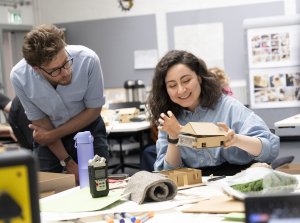
Modelmaking activity with Transforming Homes consortium
Research through design has formed the third strand of our approach. Physical modelmaking has been central to our nationwide co-design charrettes with residents, providing a shared language through which all attendees can meaningfully engage with and develop design ideas for transformation. Making these models captured participants’ thinking in tangible forms that could then be analysed in detail. Researchers from across the consortium also engaged with drawing and making activities via a series of co-design workshops, culminating in a consortium-wide charrette.
Building on this research, we have now begun to develop exploratory design strategies for 1920-1940 Council built homes. Design reviews with consortium members have added rigour, critique and richness to the iterative development of these ideas. The most recent of these reviews, involving participants from across the consortium, was not only a test of the designs themselves, but of how we can effectively communicate them to diverse audiences. Over the course of 2026, this work will evolve from exploration into a catalogue of scalable, transferable design solutions. The interdisciplinary team will define how key metrics are measured and evaluated to compare the benefits of different proposals, and these ideas will continue to be tested within the consortium and with residents and stakeholders through future co-design charrettes.
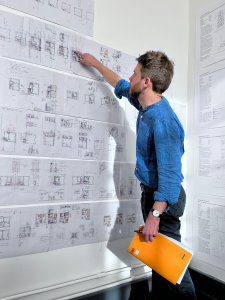
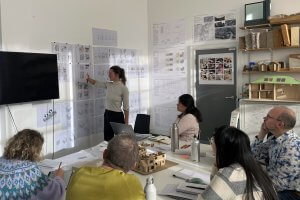
Design Review Sessions
Ultimately, the impact of the design catalogue will depend on how successfully it is communicated. Developing accessible, engaging ways to share the work with end users is therefore critical. We will embed design-led methods in all approaches to disseminating the catalogue, using interactive workshops and modelmaking to allow stakeholders to explore the proposed solutions and support their real-world uptake.
Design research approaches, in their breadth and flexibility, provide a versatile framework to interrogate the complex and interdisciplinary field of housing transformation. In a research landscape dominated by quantitative research methodologies, design research methods provide important opportunities to explore the challenges facing the housing sector, and to develop imaginative, holistic, and effective responses.